
Instruments: The Serpent Forveille
 |
|
 |
|
 |
|
 |
|
 |
|
 |
|
 |
|
 |
|
 |
|
 |
|
 |
|
 |
|
 |
|
 |
|
The serpent Forveille was introduced in 1823 by the Parisian maker Forveille. The instrument consists of three sections, a swan-shaped bocal, a "zagged middle" section of metal, and a J-shaped wooden bell-stock. Made by a variety of instruments makers other than Forveille, notably Darche, Klemmer, and Turlot, the instrument was constructed in a more uniform manner than other bass horns. The serpent Forveille offers a delicate sound and must be seen as one of hte more successful experiments among the varuiouys bass horns, invented by a gifted instrument designer who had already developed sophisticated keywork for the serpent d'eglise.
In a method written c1825, Hermenge claimed that the instrument maintained a greater and clearer range in the upper register than the serpent ordinaire, easily entering the fourth octave, and he describes the serpent Forveille as being able to match the tonal quality of the serpent yet proving, with its elegant shape, easier to hold and more capable of producing a greater volume of sound.. Hermenge's treatise includes an impressive array of duets and caprices. With six fingerholes, no thumbhole, and 3-4 keys, the serpent Forveille may represent the best balance between clear, upper octaves and a full, forceful bass register.
The instrument was most popular in France.
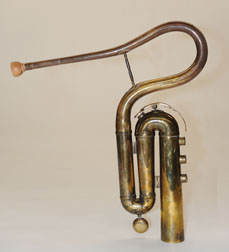
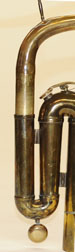
The instrument's tuning slide permits great variation so that the horn may be pitched between A=430-460.
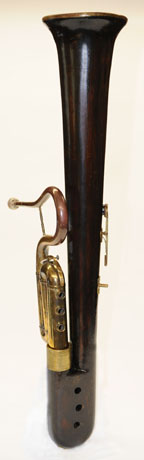
to download
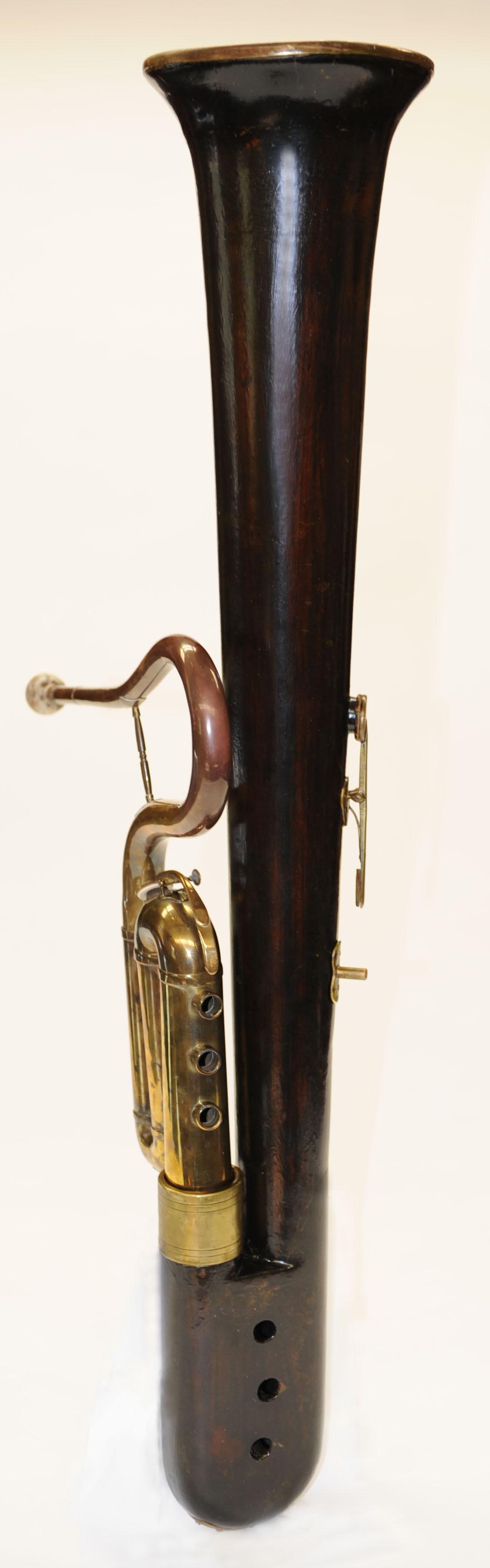
a high density image
Please include the following photo credit in any public presentation:
© Craig Kridel,
Berlioz Historical Brass
DIMENSIONS
Measurements of air column with the instrument pitched at A=440
forthcoming
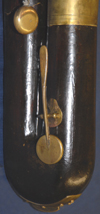
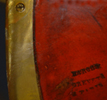
maker's signature:
Darche
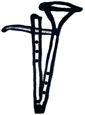
One important designation among the upright serpents is the configuration of finger holes for the lengthening of the air column. Using Mendelssohn's 1824 line drawing of the English bass horn (sent in a letter to his sister, Fanny), finger holes have been placed in order on the air column as a way to display their positioning for the serpent Forveille.
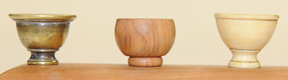
left to right: generic bass horn, serpent Forveille, serpent mouthpieces
Hermenge is adamant about the convex exterior shape of the mouthpiece (rather than the more curved, exterior cup-shape of the serpent mouthpiece) and, while allowing the diameter of the rim to be determined by the preference of the player, insists upon a narrow rim width.
For more information about this instrument, see
"The Serpent Forveille: Perhaps the Best of All These Instruments for Sound" by Craig Kridel

early 19th century brass
Piccolo Press : ITEA Historical Instrument Section : The Tigers Shout Band : Harmoniemusik : Links