
Bass Horns
The term “bass horn” represents a convenient yet somewhat confusing collective noun for upright serpents (lip-activated aerophones made of wood and metal) most popular in European military bands and chamber ensembles during the late 18th and early-mid 19th centuries. The term serves as a generic designation but also represents specific instruments including the Russian bassoon (basson russe), serpent Piffault and serpent à pavillon, English bass horn, serpent Forveille, ophimonocleide, hibernicon, Chromatische Basshorn, and cimbasso. Much inconsistency now occurs with this nomenclature, and often period accounts use the general term bass horn to describe any type of low brass, upright serpent with side-holes and a cup-shaped mouthpiece. Bass horns are open-hole instruments made of wood and metal with a folded conical bore, often pitched at an eight-foot C2, with two sets of three fingerholes that serve to close tone holes on the conical air-column, unlike the most commonly known upright serpent, the ophicleide, a closed-hole instrument where the keys serve to open tone holes.
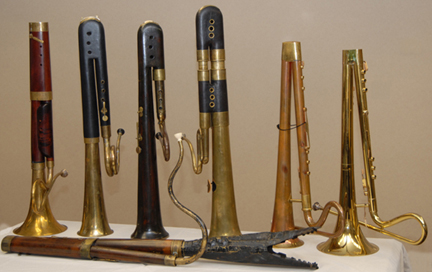
l-r: cimbasso, serpent a pavillon, serpent Forveille, ophimonocleide, English bass horns;
front: basson russe
As the traditional, curved serpent, the serpent d’église, entered the military bands of the late 18th century, the bass horn emerged during a time of great experimentation prior to the invention of mechanical valves. Designers sought to conceive a bass instrument that would be more sturdy, easier to hold, and offer better intonation. While bass horns, along with serpents, suffer from acoustically ill-placed fingerholes, the thickness of the bass horn’s walls permitted angled and flared drilling, offering greater flexibility in the size and placement of the tone-holes. The length of the instrument’s initial conical air-column, the bocal, was typically narrower and longer than the church serpent’s crook, and with a bell that was typically wider, the instruments design was thought to provide more control and clarity of sound. No bass horn can produce the same pure tone for each note; yet, instrumentalists could still attain proper intonation and volume to expand the sound of the bass part within the military or chamber ensemble. The bass horn integrates modern distinctions between the woodwind and brass families with the instrument seemingly more closely aligned to the bassoon. Further, the unique acoustical properties of the bass horn, when coupled with the bassoon, supplemented the lower harmonic range and low frequency energy and, similar to the effects of the serpent, greatly increased the perceived volume of the bassoon’s sound.
While there is great structural variety among the bocal shape, number of sections, and use of wood and metal construction, the instruments seem to have aligned themselves within two basic forms: 1) a horn constructed of two wind-columns—a bocal column and bell column—forming a V-shape (e.g., the standard English bass horn), and 2) a bassoon-shaped instrument where parallel bores were coupled by a U-joint or bassoon-like butt joint. The player’s left hand covers the fingerholes highest on the air-column while the right hand is ascribed to the lower tone-holes. The bocal column, reserved for the highest tone-holes, may be situated either to the right or to the left of the bell column. Thumbholes, if present, offered additional venting rather than providing any capability to overblow the harmonic series. Some designers placed the right-hand fingerholes on the ascending bell column, thereby lowering the placement of the tone-holes substantially on the air-column and causing the player to use a reverse fingering pattern (i.e., the index finger of the right hand would cover the lowest tone-hole).
 |
|
 |
|
 |
|
 |
|
 |
|
 |
|
 |
|
 |
|
 |
|
 |
|
 |
|
 |
|
 |
|
 |
|
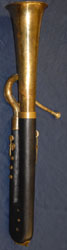
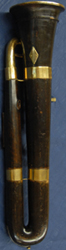
On most bassoon-configured bass horns, the exterior view of the fingerholes does not clearly depict whether tone-holes enter the bocal or bell column. For some instruments, the fourth tone-hole, appearing on the ascending bell column and covered by the annular finger of the right hand, may actually penetrate the bocal column, thereby placing substantial spacing between the third & fourth and fourth & fifth tone-holes of the air-column. Other instrument designers have placed the fifth tone-hole, appearing on the ascending bell column and covered by the middle finger of the right hand, so that flared-drilling of the hole permits the penetration of both the bocal and bell columns.
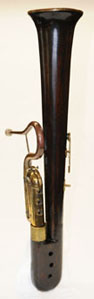
Serpent Forveille
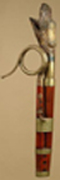
Basson russe
While the term “basson russe” refers typically, although not consistently, to a dragon-headed bass horn (similar to the buccin, the dragon-headed trombone) in contrast to generic bass horns without a zoomorphic bells. No consensus exists, yet linguistic usage suggests that the term “serpent-basson” is a more convenient identification for these miscellaneous, bassoon-shaped bass horns with conventional, metal bells.
Serpents and bass horns co-existed during the late 18th and early 19th centuries, and bass horns should not be viewed as a successful or unsuccessful effort to displace the military serpent. Two English bass hornists, Hattersley of Sheffield and Tricket of Scarbrough, performed in the orchestra of the 1823 York Festival, doubling the bass line along with two serpentists. Rather, bass horn design and construction show remarkable ingenuity and creativity by designers during a burgeoning era of experimentation among brass and woodwind instruments. Each bass horn, with its varying proportions of brass-to-wood and different fingering patterns and placement of tone-holes along the air-column, represents an insightful and imaginative acoustical design. These instruments should not be dismissed for their lack of agility when compared to today’s valved, brass instruments. Much of the bass horn’s military & harmoniemusik role was to blend and engulf the bass sound that combined brass with reed instruments. Too often today, bass horns are discredited for their weak intonation, lack of dexterity and, when heard alone, atypical tone quality. In fact, acoustical blending may have been their greatest ability and most important feature.
Craig Kridel
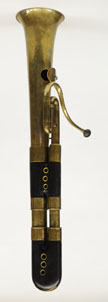
Ophimonocleide
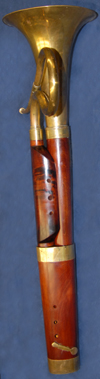
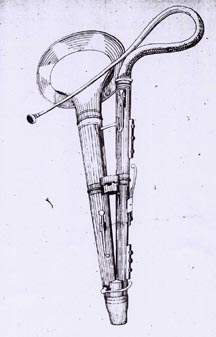
While upright serpents are typically lumped into the category of bass horns, there are dramatic differences among the instruments. Makers experimented extensively with materials, construction design, and fingering patterns. One important designation among the upright serpents is the configuration of finger holes for the lengthening of the air column. Using Mendelssohn's 1824 line drawing of the English bass horn (sent in a letter to his sister, Fanny), finger holes have been placed in order on the air column as a way to display their positioning.
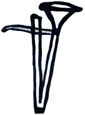
An interesting issue is whether the right hand finger holes are drilled into the upper, left air column or whether they are crossed drilled into the lower, right column. This will be depicted on the individual pages of each bass horn.


Home : About : Music & Recordings : Performances : Players : Repertoire : Instruments : Contact
Piccolo Press : ITEA Historical Instrument Section : The Tigers Shout Band : Harmoniemusik : Links